
The Jack Russell Terrier Breed Standard Explained
A clear, visual guide to understanding the structure, proportions, head, movement, temperament and coat types that define a correct Jack Russell Terrier.
What should a Jack Russell Terrier be like?
A breed standard does not describe appearance alone. It also defines the functional structure, temperament and essential qualities that preserve the character of a true working terrier.
The Jack Russell Terrier should be compact, resilient, flexible, balanced and able to move with speed and efficiency. Its body should never appear heavy, but neither should it look fragile.
This guide explains the most important points of the standard using photographs of real dogs, practical breeder observations and clear language for owners, enthusiasts and anyone interested in understanding the breed properly.
Official breed information
The Jack Russell Terrier is internationally recognised by the Fédération Cynologique Internationale under breed standard number 345.
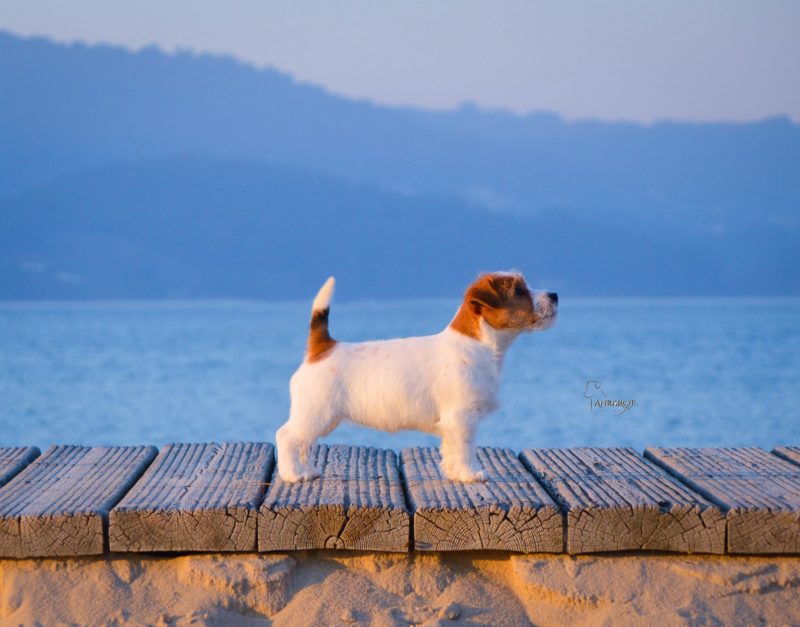
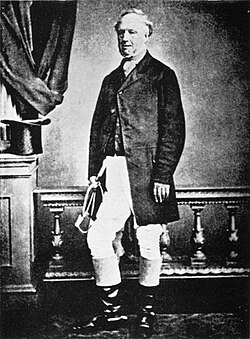
The story of the Reverend Jack Russell
The history of the breed is closely linked to the Reverend John Russell, commonly known as Jack Russell, a British clergyman with a passion for hunting and working terriers.
During the nineteenth century, he sought small, tough and courageous dogs capable of keeping up with horses and entering fox earths to bolt the fox without engaging in unnecessary combat.
Those terriers needed to combine speed, stamina, flexibility and a sufficiently moderate chest to work underground.
Australia later played a major role in preserving, organising and securing international recognition for the Jack Russell Terrier as a distinct breed.
A terrier built to work
Every feature described in the standard should support mobility, stamina and the ability to work in confined spaces.
Flexible body
The dog should be able to turn, advance and reverse with ease. Flexibility is an essential breed characteristic.
Moderate chest
It should never be excessively wide or round. The chest should be spannable behind the shoulders.
Functional limbs
The legs should produce free, efficient and coordinated movement.
Terrier temperament
The dog should be lively, intelligent, confident, alert and courageous, without marked shyness or unjustified aggression.
General appearance of the Jack Russell Terrier
The breed should present an active, balanced and functional outline, with a flexible body and an alert expression.
The standard describes the Jack Russell Terrier as a strong, active, agile working terrier with great character. Its body should be flexible and of medium length.
Viewed from the side, the body should be slightly longer than the height at the withers. No single feature should dominate through exaggeration: not an oversized head, an excessively wide chest or legs that are too short.

The most important proportions
The relationship between height, length, chest depth and leg length is essential to preserving correct breed type.
Slightly longer than tall
The length of the body should be slightly greater than the height at the withers.
Depth of body
The distance from the withers to the underside of the chest should be approximately equal to the distance from the underside of the chest to the ground.
Chest span
The chest should be spannable behind the shoulders by the hands of an average-sized adult.
Height and weight
The ideal height is between 25 and 30 cm. As a traditional guide, approximately 1 kg of weight is expected for every 5 cm of height.
The head of the Jack Russell Terrier
The head should convey intelligence, alertness and terrier character while maintaining clean, balanced proportions.
Skull
It should be flat and of moderate width, gradually narrowing towards the eyes.
Stop
It should be defined, but never exaggerated.
Muzzle and jaws
The muzzle should be strong and proportionate. The jaws should be deep, wide and powerful.
Nose, eyes and ears
The nose should be black; the eyes small, dark and keen; and the ears button or dropped.
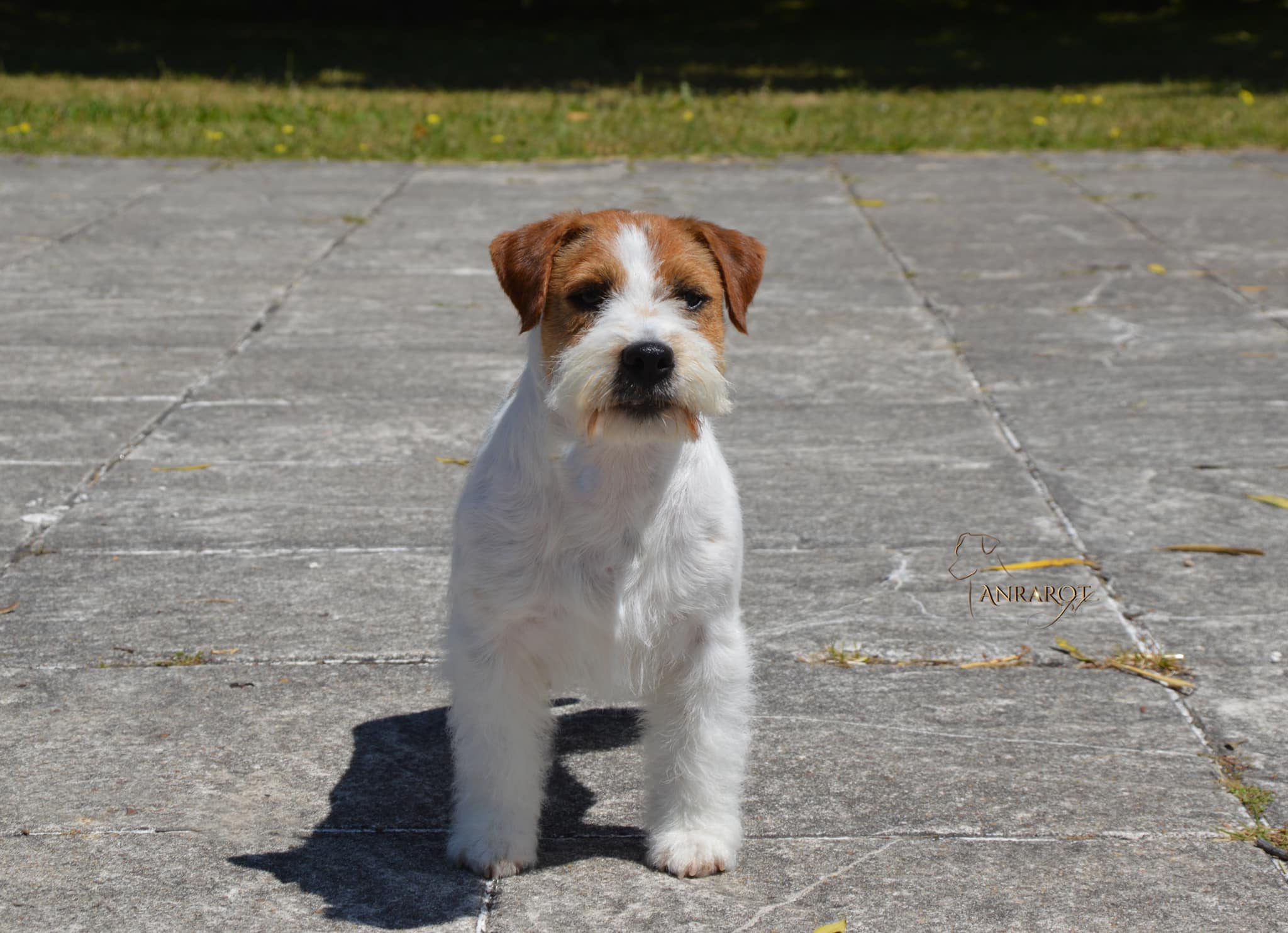
Algrafs Ace Gagarin. A visual example used to explain the main points of the head.
Eyes, ears, mouth and dentition
The eyes should be small and dark, never prominent. The expression should be keen, lively and intelligent.
The ears are a major part of breed expression. They should be button or dropped, with good texture and mobility.
The lips should be close-fitting and pigmented. The correct bite is a scissor bite, with strong, properly set teeth.
Character and temperament
- Lively, alert and active.
- Intelligent and self-confident.
- Courageous, but not aggressive without cause.
- Friendly and willing.
- Capable of working and living closely with its family.
Body, chest, tail and limbs
The body should be strong, flexible and proportionate, with a structure that supports stamina and efficient movement.
Neck
Strong, clean and sufficiently long to allow a balanced head carriage.
Back and loin
The topline should be firm and level. The loin should be short, strong and muscular.
Chest
Deep rather than wide, with ribs well sprung from the spine and flattening at the sides.
Tail
It may hang at rest but should be carried upright when the dog is moving or alert.
Forequarters
Straight, with good bone and shoulders laid well back, without excessive muscle development.
Hindquarters
Strong, muscular and well angulated, providing drive without exaggeration.
Free, coordinated and efficient
Correct movement should be unrestricted, balanced and purposeful, without forced or exaggerated action.
The forelegs should move forward cleanly while the hindquarters provide drive. The dog should remain balanced with a stable topline.
What correct movement should convey
- Freedom of movement.
- Coordination between front and rear.
- Good reach and drive.
- Stability through the body.
- No stiffness or shortened stride.
Jack Russell Terrier coat types
The standard recognises three coat varieties: smooth, broken and rough. In every case, the coat should be weather-resistant.
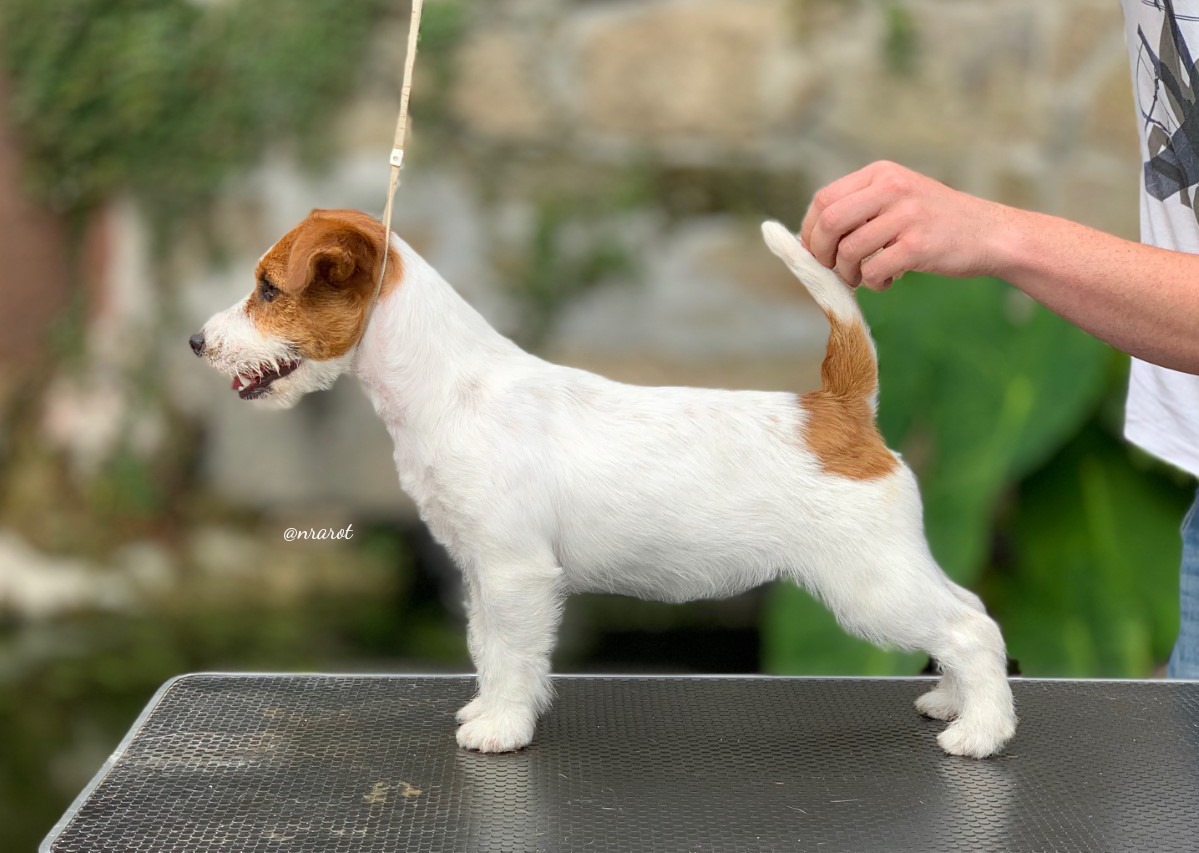
Cora Vom Anrarot
The broken coat combines shorter areas with patches of longer, harsher hair. It often includes a discreet beard and eyebrows without the fuller furnishings of a rough coat.
It should retain a protective texture and must never appear soft, woolly or excessively sculpted.
Harsh, protective coat
The rough coat provides fuller coverage, with a beard, eyebrows and a strong texture to the touch.
Correct maintenance is carried out by hand stripping, preserving the coat's natural texture and colour.
Smooth coat
Short, dense and close to the body. It should also be weather-resistant and provide adequate protection.
Colour
White should predominate, with black, tan or black-and-tan markings. Tan markings may range from pale shades to richer chestnut tones.
How the standard develops as a puppy grows
A puppy is not a miniature adult. Proportions, head shape, ribcage, muscle development and coat all change during the first months of life.
Assessment requires experience and should focus on developmental tendencies rather than drawing final conclusions too early.
Faults in the breed standard
Any departure from the standard should be assessed according to its severity and its effect on health, welfare, function and breed type.
Faults of construction or type
- Lack of true terrier characteristics.
- Imbalance or exaggeration in any part.
- Weak, restricted or poorly coordinated movement.
- Incorrect dentition or bite.
- A chest that is too wide or a body that is excessively heavy.
- Insufficient pigmentation.
Disqualifying faults
- Aggression or extreme shyness.
- Clearly serious physical or behavioural abnormalities.
- Features incompatible with health or function.
- Male dogs without two apparently normal testicles fully descended into the scrotum.
Understanding the standard helps you understand the breed
At Vom Anrarot, we select our dogs for health, temperament, balance, correct structure and faithfulness to the authentic Jack Russell Terrier.